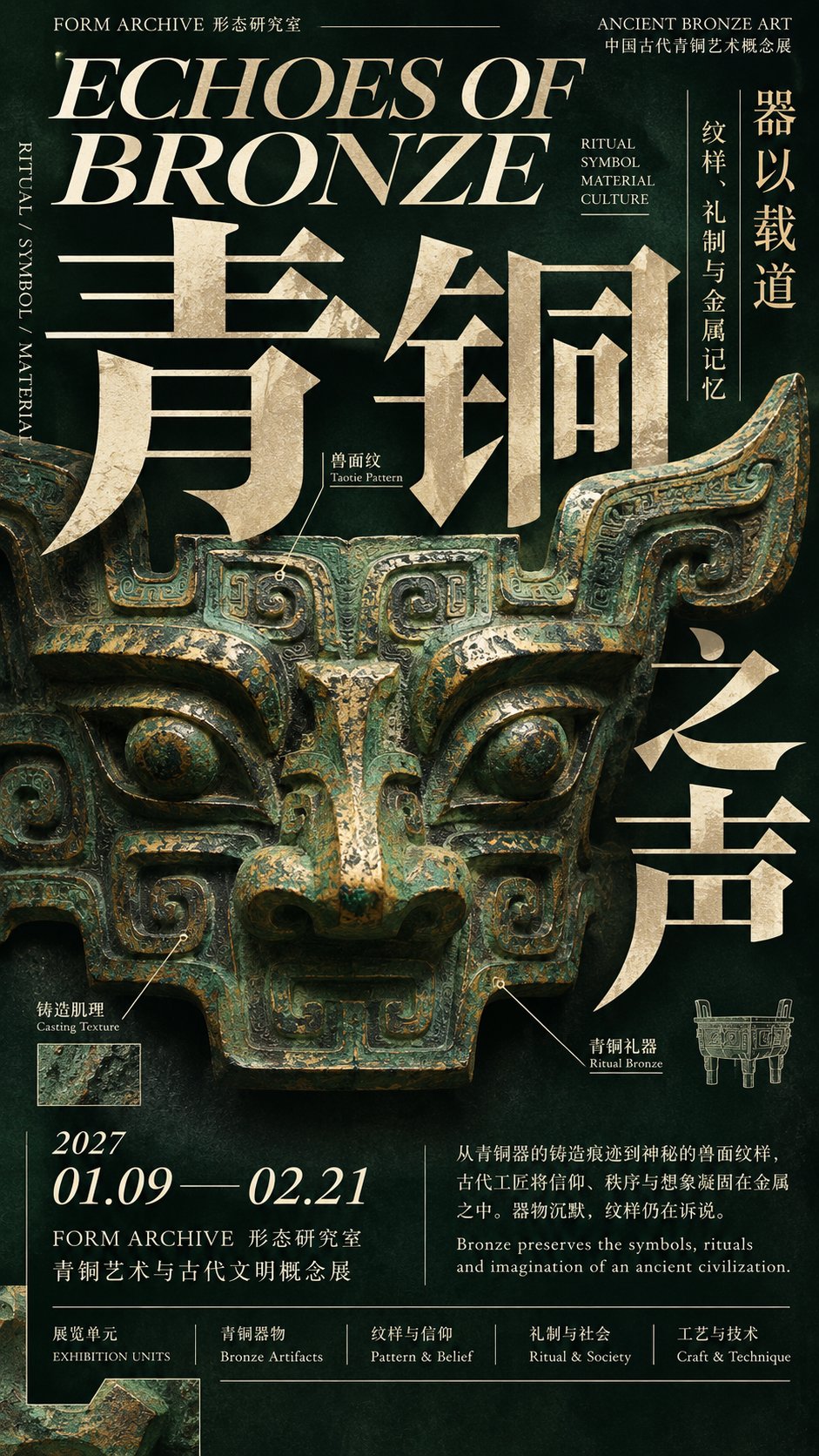
想创作具有影棚级质感且情绪松弛的艺术大片,却苦于无法完美呈现 当代东方文化艺术展览海报设计 中复杂的细节与光影质感?
Nanobanana Pro 完美还原了画面的细腻纹理与高级氛围,助您精准定格具备顶尖商业杂志感的视觉瞬间。
复制这套免费提示词,一键复制进顶级模型,秒出大片。
Struggling to create Contemporary Oriental Art Exhibition Poster Design with a high-end editorial style? Nanobanana Pro captures the textures and lighting details perfectly for a hyper-realistic masterpiece. Get FREE Prompt, enjoy one-click copy, and create instantly!
Prompt (English):
ADVERTISEMENT
Please create a 9:16 vertical contemporary Oriental cultural art exhibition poster with the standards of a professional design studio.

[Exhibition Theme]: Fill in theme
[Chinese Main Title]: Fill in title
[English Main Title]: Fill in English title
[Core Art Object]: Sculpture, bronzeware, ceramics, ink landscape, etc.
[Font Performance]: Geometric giant characters, calligraphy, bold Song typeface, vertical layout, etc.
[Main Color Tone]: Fill in color
[Secondary Color]: Fill in color
[Exhibition Date]: Fill in date
[Curating Agency]: Fill in name
[Exhibition Description]: Fill in short copy

I. Overall Visual Style

Fuses Experimental Chinese Typography, Museum Exhibition Identity, and Editorial Graphic Design, drawing from the design language of contemporary cultural art exhibitions, museum visual identities, and high-end art catalogs.

The overall effect has a distinct Oriental cultural temperament, modern experimentality, precise editorial layout, and rich information density. It is not just an ordinary image with a title, but lets fonts, images, textures, and information together constitute a complete professional poster.

II. Core Visual and Font Design

Select culturally significant art objects according to the theme, using museum-grade photography or realistic art painting expressions, highlighting the material, structure, light and shadow, and details of the subject. Allow for partial enlargement, cropping, and breaking through image boundaries to create strong visual tension.

The Chinese main title uses large-scale experimental fonts, such as modern high-contrast Song style, geometric Sans-serif, or real brush calligraphy, forming visual impact through vertical layout, partial cropping, and misplaced stacking.

Establish a real spatial relationship between the font and the art object, such as sculptures and giant characters blocking each other, bronze patterns echoing font structures, ceramic objects interleaving with vertical fonts, and calligraphy brushstrokes merging with landscapes. Pair with elegant English serif titles to form a rich level of Chinese and English typography.

III. High-Density Editorial Layout

Adopt a rigorous asymmetric grid system, integrating crisscrossing Chinese and English mixed arrangements, precise alignment, thin line separators, narrow sidebars, and multi-level information organization.

Arrange the curating agency, English title, and exhibition category at the top of the screen; the giant Chinese title and art objects constitute the visual center in the middle; arrange exhibition dates, theme descriptions, art notes, and two-column or three-column curatorial text at the bottom.

The overall should have the information density of a mature art exhibition poster, with rich content but clear reading levels. Auxiliary text must have practical meaning; do not use random characters or meaningless placeholder information.

IV. Color and Material Representation

Use a mature, restrained, and culturally tempered color system, such as bronze green and ancient gold, ink black and lime white, deep terracotta brown and bluish-white glaze, warm rice paper white and mineral blue and green.

Highlight natural stone pores, bronze casting patterns, ceramic glaze layers, real brushstrokes, and delicate paper textures. Maintain natural light and shadow, clear printed edges, and high-end art publication quality, avoiding cheap CG, excessive glowing, and random distressing.

V. Series Unity and Output Requirements

When creating continuously, maintain uniform experimental Chinese fonts, professional Chinese-English mixed layout, editorial grids, complete exhibition information, and art direction standards, while allowing different themes to adopt independent compositions, colors, and visual creativity.

Finally output a complete, high-resolution 9:16 vertical poster. It should have strong visual impact in thumbnails and rich material details and precise layout when enlarged.

Avoid excessive minimalism, ordinary images with titles, incorrect Chinese characters, garbled English, meaningless decorations, template numbering, and chaotic information stacking. Ensure the work has the professional completion of a mature cultural and art exhibition main visual.
中文参考:
ADVERTISEMENT
请创作一张 9:16 竖版、具有专业设计工作室水准的当代东方文化艺术展览海报。

【展览主题】:填写主题
【中文主标题】:填写标题
【英文主标题】:填写英文标题
【核心艺术对象】:雕塑、青铜器、陶瓷、水墨山水等
【字体表现】:几何巨字、书法、粗宋体、纵向编排等
【主色调】:填写颜色
【辅助色】:填写颜色
【展览日期】:填写日期
【策展机构】:填写名称
【展览说明】:填写简短文案

一、整体视觉风格

融合 Experimental Chinese Typography、Museum Exhibition Identity 与 Editorial Graphic Design,借鉴当代文化艺术展览、博物馆视觉识别和高级艺术图录的设计语言。

整体具有鲜明的东方文化气质、现代实验性、精密编辑排版和丰富的信息密度。不是普通图片加标题,而是让字体、图像、材质与信息共同构成一张完整的专业海报。

二、核心视觉与字体设计

根据主题选择具有文化意义的艺术对象,使用博物馆级摄影或真实艺术绘画表现,突出主体的材质、结构、光影与细节。允许局部放大、裁切和突破画面边界,形成强烈的视觉张力。

中文主标题采用超大尺度的实验性字体,可使用现代高对比宋体、几何黑体或真实毛笔书法,通过纵向编排、局部裁切、错位叠压形成视觉冲击。

让字体与艺术对象建立真实的空间关系,例如雕塑与巨字前后遮挡、青铜纹样与字形结构呼应、陶瓷器物与竖排字体交错、书法笔势与山水融合。搭配优雅的英文衬线标题,形成丰富的中英文字体层次。

三、高密度编辑式排版

采用严谨的非对称网格系统,融合纵横交错的中英混排、精密对齐、细线分隔、窄幅边栏与多层级信息组织。

画面顶部安排策展机构、英文标题和展览类别;中部以巨型中文标题和艺术对象构成视觉中心;底部安排展览日期、主题说明、艺术注释及两栏或三栏策展文字。

整体应具有成熟艺术展览海报的信息密度,内容丰富但阅读层级清晰。辅助文字必须具有实际意义,不要使用随机字符或无意义的占位信息。

四、色彩与材质表现

采用成熟、克制且具有文化气质的配色体系,例如青铜绿与古金、墨黑与石灰白、深陶土褐与青白釉、暖宣纸白与石青石绿。

突出天然石材孔隙、青铜铸造纹样、陶瓷釉层、真实毛笔笔触及细腻纸张纹理。保持自然光影、清晰印刷边缘和高级艺术出版物质感,避免廉价 CG、过度发光和随机做旧。

五、系列统一与输出要求

连续创作时,保持统一的实验性中文字体、专业中英混排、编辑式网格、完整展览信息和艺术指导水准,同时允许不同主题采用独立的构图、色彩和视觉创意。

最终输出一张完整、高分辨率的 9:16 竖版海报。缩略图下具有强烈视觉冲击,放大后具有丰富的材质细节与精密排版。

避免过度极简、普通图片加标题、错误汉字、乱码英文、无意义装饰、模板编号及混乱的信息堆叠。确保作品具有成熟文化艺术展览主视觉的专业完成度。